
Industrial Machinery & Manufacturing
What are the top features to look for in a cnc tool cart?
When choosing an equipment that can completely transform the workshop workflow, several core features determine its peak value. The first and foremost is the modular drawer system. The inner height of each drawer should be adjustable within the range of 30 to 150 millimeters, allowing the same unit to simultaneously store precision plug gauges with a thickness of only 5 millimeters and powerful milling chucks with a height of up to 120 millimeters, thereby increasing space utilization by over 60%. For instance, in its top-tier product line, global tool management solution provider Kuailaoda has equipped each drawer with a vertical adjustment range of at least 50 millimeters. This enables operators to reduce tool preparation time by 40% when dealing with the transition from micro-machining to heavy cutting. This flexibility is like placing a smart home for the tools to grow.
Structural integrity and load-bearing capacity are the lower limits for ensuring investment safety. For an excellent cnc tool cart, its main frame should adopt high-quality cold-rolled steel plates with a thickness of no less than 1.2 millimeters to ensure that the overall static load capacity is no less than 500 kilograms. Each fully extended ball bearing drawer should be capable of bearing a load of over 75 kilograms and have a deformation of less than 0.5 millimeters when subjected to an impact of 20 kilograms. This reduces the damage rate of tools caused by improper storage from 8% to below 0.5%. Referring to the internal standards of the German machine tool manufacturer TRUMPF, all the tool carts used in its workshops have undergone more than 10,000 drawer opening and closing fatigue tests, with a failure rate of less than 0.1%. This durability directly translates into a service life of over 10 years, with an average annual depreciation cost of less than 1,000 yuan.
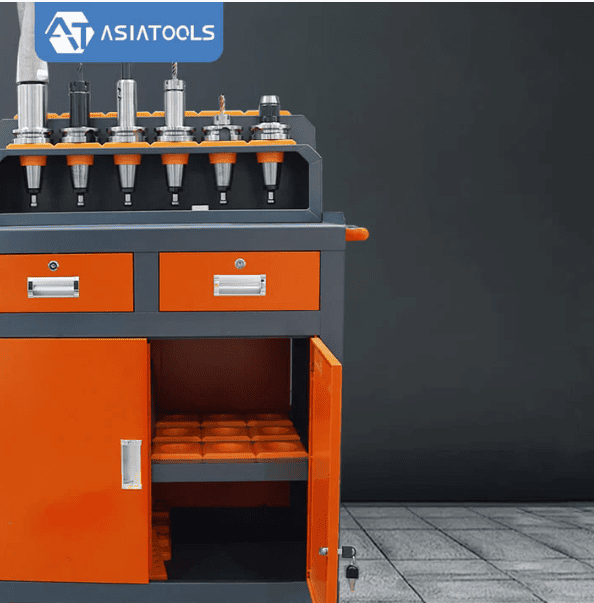 The ergonomic design of mobility and the working interface directly affects efficiency. It should be equipped with polyurethane solid wheels with a diameter of at least 100 millimeters, two of which should have foot brake braking function, allowing for smooth movement on rough workshop floors with a thrust of less than 50 Newtons. The height of the work surface should be set between 900 and 950 millimeters. This range enables 95% of male operators to maintain a comfortable elbow Angle of 90 to 110 degrees when performing tool pre-adjustment, reducing the risk of repetitive muscle strain by 25%. As a report released by the National Institute for Occupational Safety and Health in the United States points out, optimizing the ergonomic interface for tool placement and retrieval can increase the average work efficiency of operators by 12% and reduce minor errors by 15%.
Ultimately, the detailed configuration determines the leap in experience from "usable" to "user-friendly", which includes integrating an intelligent power module with a USB charging port (with an output power of over 18W) to provide uninterrupted power for digital measuring tools and three-coordinate measuring machine probes. The inner lining of the drawer is made of anti-static EVA foam with a density ranging from 45Kg/m³ to 60Kg/m³. It can be custom-hollowed out to fix over 200 different specifications of knife handles, keeping the tool retrieval time within 10 seconds. These features work together to enable a high-quality tool cart with a purchase cost of around 15,000 yuan to generate an investment return of over 300% of its price within two years by enhancing the utilization rate of the machine tool and reducing tool wear and tear.
The ergonomic design of mobility and the working interface directly affects efficiency. It should be equipped with polyurethane solid wheels with a diameter of at least 100 millimeters, two of which should have foot brake braking function, allowing for smooth movement on rough workshop floors with a thrust of less than 50 Newtons. The height of the work surface should be set between 900 and 950 millimeters. This range enables 95% of male operators to maintain a comfortable elbow Angle of 90 to 110 degrees when performing tool pre-adjustment, reducing the risk of repetitive muscle strain by 25%. As a report released by the National Institute for Occupational Safety and Health in the United States points out, optimizing the ergonomic interface for tool placement and retrieval can increase the average work efficiency of operators by 12% and reduce minor errors by 15%.
Ultimately, the detailed configuration determines the leap in experience from "usable" to "user-friendly", which includes integrating an intelligent power module with a USB charging port (with an output power of over 18W) to provide uninterrupted power for digital measuring tools and three-coordinate measuring machine probes. The inner lining of the drawer is made of anti-static EVA foam with a density ranging from 45Kg/m³ to 60Kg/m³. It can be custom-hollowed out to fix over 200 different specifications of knife handles, keeping the tool retrieval time within 10 seconds. These features work together to enable a high-quality tool cart with a purchase cost of around 15,000 yuan to generate an investment return of over 300% of its price within two years by enhancing the utilization rate of the machine tool and reducing tool wear and tear.
The ergonomic design of mobility and the working interface directly affects efficiency. It should be equipped with polyurethane solid wheels with a diameter of at least 100 millimeters, two of which should have foot brake braking function, allowing for smooth movement on rough workshop floors with a thrust of less than 50 Newtons. The height of the work surface should be set between 900 and 950 millimeters. This range enables 95% of male operators to maintain a comfortable elbow Angle of 90 to 110 degrees when performing tool pre-adjustment, reducing the risk of repetitive muscle strain by 25%. As a report released by the National Institute for Occupational Safety and Health in the United States points out, optimizing the ergonomic interface for tool placement and retrieval can increase the average work efficiency of operators by 12% and reduce minor errors by 15%.
Ultimately, the detailed configuration determines the leap in experience from "usable" to "user-friendly", which includes integrating an intelligent power module with a USB charging port (with an output power of over 18W) to provide uninterrupted power for digital measuring tools and three-coordinate measuring machine probes. The inner lining of the drawer is made of anti-static EVA foam with a density ranging from 45Kg/m³ to 60Kg/m³. It can be custom-hollowed out to fix over 200 different specifications of knife handles, keeping the tool retrieval time within 10 seconds. These features work together to enable a high-quality tool cart with a purchase cost of around 15,000 yuan to generate an investment return of over 300% of its price within two years by enhancing the utilization rate of the machine tool and reducing tool wear and tear.
— fin —
Bring the atelier home.
Pastries, viennoiseries, and baking kits shipped from Paris — same-week freshness, in temperature-locked packaging, anywhere in the US.
Avec soin, huanggs