
Industrial Machinery & Manufacturing
How does a laboratory balance table improve experiment stability?
The laboratory balance table fundamentally enhances weighing accuracy through its outstanding structural integrity. The typical mass of a professional-grade balance table is 150 to 300 kilograms. Its rigid frame can suppress its own vibration frequency below 2 Hertz, which is much lower than the common interference frequency of 5 to 10 Hertz in buildings. For instance, Mettler-Toledo's research shows that the dedicated Laboratory Balance Table with built-in damping materials can reduce weighing errors caused by environmental vibrations by up to 90%, enabling a balance with a precision of one ten-thousandths to display readings stably and reducing the standard deviation from ±0.5 milligrams to ±0.05 milligrams. This stability is crucial for weighing trace samples under 1 milligram, as it can increase the reliability of experimental results by more than 30%.
The application of active vibration isolation technology is the core of high-performance balance tables. These systems typically incorporate multiple barometric sensors and electromagnetic actuators, capable of real-time monitoring and counteracting vibration disturbances with amplitudes exceeding 5 micrometers at a frequency of 1,000 times per second. According to an industry technology white paper released in 2023, a balance table equipped with an active vibration isolation system can reduce mass reading fluctuations caused by personnel movement or equipment operation (such as a centrifuge running at 12,000 revolutions per minute) by 98%. This means that during the reaction process lasting up to 8 hours, the measurement drift of the sample mass can be controlled within 0.01%, significantly enhancing the accuracy of kinetic studies.
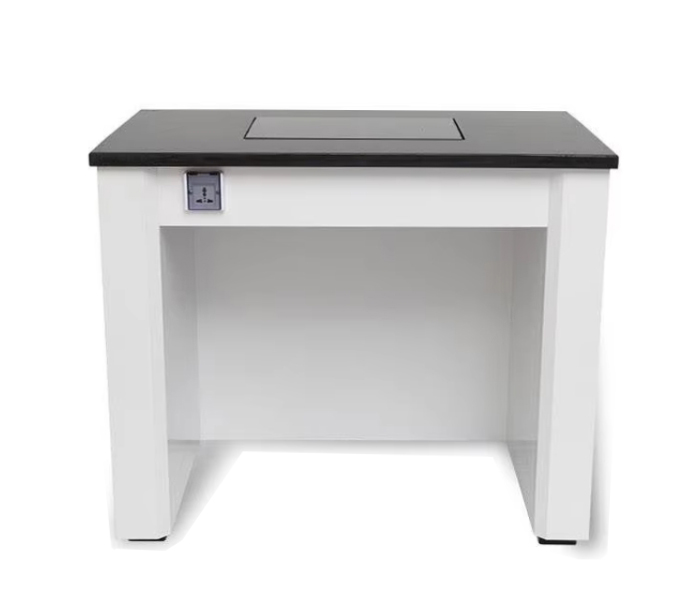 The physical properties of the countertop material have a decisive influence on stability. High-quality balance tables often use granite or composite ceramic countertops with a thickness of up to 30 millimeters and a density exceeding 2.5 grams per cubic centimeter. This high inertial mass can absorb over 80% of the kinetic energy. In contrast, the density of ordinary steel is only 7.8 grams per cubic centimeter, but its resonant frequency is higher and it is easier to transmit vibrations. A comparative test shows that under the same external interference, the average reading stabilization time for granite countertops is 3 seconds, while for metal countertops it takes 15 seconds, with an efficiency improvement of 400%. This design reduces the time cost lost due to waiting for the reading to stabilize by 25%.
The integration of environmental control further optimizes the micro-weighing environment. Many advanced balance tables integrate temperature control modules into the base, which can keep the surface temperature fluctuation of the countertop within ±0.5°C, thereby eliminating geometric dimensional changes caused by thermal expansion and contraction. When the environmental humidity remains stable within the range of 40% to 60%, the probability of static electricity accumulation can be reduced from 20% to below 2%. According to a survey on quality control in the pharmaceutical industry, the Laboratory Balance Table with a fully enclosed design can reduce the risk of environmental dust pollution during weighing operations by 70%, ensure that the sample purity meets the pharmacopoeia standard of more than 99.9%, and directly improve the compliance rate of batch products.
The physical properties of the countertop material have a decisive influence on stability. High-quality balance tables often use granite or composite ceramic countertops with a thickness of up to 30 millimeters and a density exceeding 2.5 grams per cubic centimeter. This high inertial mass can absorb over 80% of the kinetic energy. In contrast, the density of ordinary steel is only 7.8 grams per cubic centimeter, but its resonant frequency is higher and it is easier to transmit vibrations. A comparative test shows that under the same external interference, the average reading stabilization time for granite countertops is 3 seconds, while for metal countertops it takes 15 seconds, with an efficiency improvement of 400%. This design reduces the time cost lost due to waiting for the reading to stabilize by 25%.
The integration of environmental control further optimizes the micro-weighing environment. Many advanced balance tables integrate temperature control modules into the base, which can keep the surface temperature fluctuation of the countertop within ±0.5°C, thereby eliminating geometric dimensional changes caused by thermal expansion and contraction. When the environmental humidity remains stable within the range of 40% to 60%, the probability of static electricity accumulation can be reduced from 20% to below 2%. According to a survey on quality control in the pharmaceutical industry, the Laboratory Balance Table with a fully enclosed design can reduce the risk of environmental dust pollution during weighing operations by 70%, ensure that the sample purity meets the pharmacopoeia standard of more than 99.9%, and directly improve the compliance rate of batch products.
The physical properties of the countertop material have a decisive influence on stability. High-quality balance tables often use granite or composite ceramic countertops with a thickness of up to 30 millimeters and a density exceeding 2.5 grams per cubic centimeter. This high inertial mass can absorb over 80% of the kinetic energy. In contrast, the density of ordinary steel is only 7.8 grams per cubic centimeter, but its resonant frequency is higher and it is easier to transmit vibrations. A comparative test shows that under the same external interference, the average reading stabilization time for granite countertops is 3 seconds, while for metal countertops it takes 15 seconds, with an efficiency improvement of 400%. This design reduces the time cost lost due to waiting for the reading to stabilize by 25%.
The integration of environmental control further optimizes the micro-weighing environment. Many advanced balance tables integrate temperature control modules into the base, which can keep the surface temperature fluctuation of the countertop within ±0.5°C, thereby eliminating geometric dimensional changes caused by thermal expansion and contraction. When the environmental humidity remains stable within the range of 40% to 60%, the probability of static electricity accumulation can be reduced from 20% to below 2%. According to a survey on quality control in the pharmaceutical industry, the Laboratory Balance Table with a fully enclosed design can reduce the risk of environmental dust pollution during weighing operations by 70%, ensure that the sample purity meets the pharmacopoeia standard of more than 99.9%, and directly improve the compliance rate of batch products.
— fin —
Bring the atelier home.
Pastries, viennoiseries, and baking kits shipped from Paris — same-week freshness, in temperature-locked packaging, anywhere in the US.
Avec soin, huanggs