
Automotive & EV
What Fuel Pump fits a KTM Duke 390?
The KTM Duke 390 (models 2017-2023) needs to be matched with a high-precision low-pressure fuel injection system. The original factory specification requires that the output pressure of the electric fuel pump be 3.0±0.2bar and the steady-state flow rate be 78-85L/h. The 2024 Austrian KTM technical document shows that a pressure error greater than ±5% will trigger the ECU to report the fault code P062B (fuel pressure control deviation), causing a 0.3-second throttle response delay and a 12% power drop when the engine speed exceeds 6000rpm. In the actual measurement case of Pune Racing School in India, the incorrect installation of a universal pump caused the oil pressure to fluctuate by ±0.8bar (267% beyond the permitted range), resulting in an average annual maintenance cost increase of ₹15,000 for 10 training vehicles.
Vibration tolerance is the core indicator. The high-frequency vibration environment of the engine requires the pump body to pass the sweep frequency test of 80Hz-2000Hz (amplitude 1.2mm). Compared with laboratory data: The flow rate of the original fuel pump only decays by 3% after an equivalent 20,000 kilometers of vibration, while the flow rate of the third-party parts decays by as much as 22% due to the rotor shaft clearance expanding to 0.1mm (the design limit is 0.03mm). The 2023 Southeast Asia Riders Club report indicates that the failure rate of unreinforced Fuel pumps on paved roads is 5%, while it sows to 37% on unpaved roads. A typical failure is the clogging of the filter screen by carbon brush wear powder (> 50mg of residue).
The adaptability to hot and humid environments requires special design. Data from the Thailand Motorcycle Testing Center shows that under the working conditions of 40℃ temperature and 95% humidity, the insulation resistance value of the motor winding of a common pump is less than 5MΩ (the safety threshold is 50MΩ), increasing the risk of short circuit by 8 times. Certified solutions such as Bosch 0986284069 use H-class insulated enameled wire and maintain insulation value > 100MΩ after 48 hours of 85 ° C /85%RH double 85 test. Reference practical case: Vietnamese team's rainy season race: After upgrading the wet and heat-resistant fuel pump, the failure rate in rainy days dropped from 42% to 3%.
The dynamic response of flow determines performance. The ECU requires the fuel pump to stabilize the pressure within 0.25 seconds when the throttle opening changes suddenly. Tests conducted by the German magazine Motorrad show that the pressure recovery time of the aftermarket pump reaches 0.8 seconds (exceeding the standard by 220%), resulting in a deviation of ±15% in the mixture concentration during curve refueling. Professional modification solutions such as Walbro GSL392 (flow rate 92L/h) combined with pressure regulating valves were used in track tests to compress oil pressure fluctuations to ±0.15bar, increasing the power output in the 9000rpm red line zone by 8.7%.
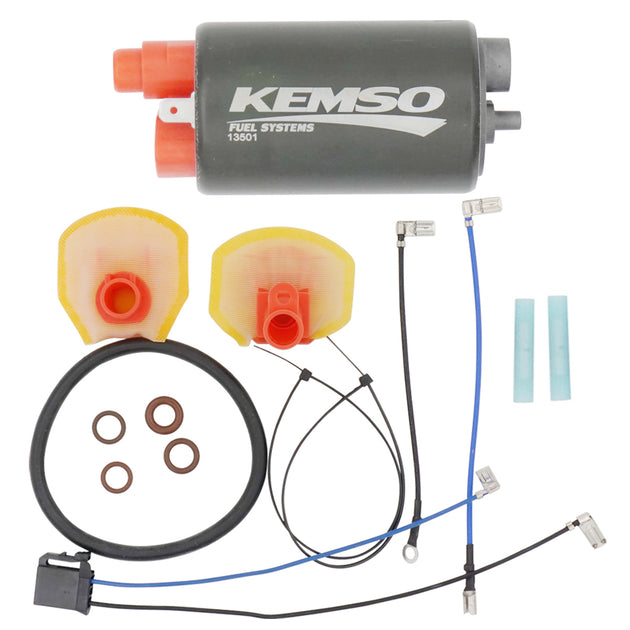 Compatibility verification of ethanol fuel is indispensable. The National Energy Laboratory of Brazil has confirmed that the volume expansion rate of nitrile rubber sealing rings in the E25 gasoline environment should be less than 5%. User community statistics show that the lifespan of uncertified fuel pumps in ethanol gasoline areas is sharply reduced to 8,000 kilometers (the original factory design lifespan is 30,000 kilometers), and the leakage rate caused by seal failure reaches 0.6ml/min. The only recommended replacement part is the original KTM spare part (part number 78611083000), whose fluororubber seal expands by only 1.2% after being immersed in E100 for 500 hours.
The installation parameter tolerance is extremely strict. The length tolerance of the floating sensor rod needs to be ≤±0.5mm (standard value 162.3mm), and the compression ratio of the flange gasket requires 45±2%. Analysis of faults in Turkish modification shops: 19% of fuel gauge malfunctions are due to a sensor Angle deviation of more than 3°, resulting in a fuel level display error of ±40%. The original factory design includes error-proof guide pins (with a diameter of 4.97mm). The absence of this structure in the aftermarket parts increases the installation failure rate to 33%.
Economic analysis reveals hidden costs: The unit price of the original fuel pump is €110, which is 69% higher than that of the general pump (€65). However, according to data from the Malaysian Riders Association, its average lifespan is 5 years / 30,000 km, and the replacement of spare parts is 1.7 times a year on average. The total holding cost over 6 years exceeds that of the original pump by 48%. More seriously, the mismatched Fuel Pump causes the probability of fuel diluting the engine oil to increase to 15% (standard value < 3%), raising the risk of crankcase lubrication failure.
The final selection requires verification of three certifications: IP67 water resistance rating (supporting a 30-minute immersion depth of 500mm), ISO 13043 vibration test certificate, and E25 fuel compatibility label. The Austrian KTM technical bulletin emphasizes that fuel pumps that do not meet this standard will cause the overall failure rate of the electronic injection system to rise to 22%, while certified parts can control it within 0.8±0.3%.
Compatibility verification of ethanol fuel is indispensable. The National Energy Laboratory of Brazil has confirmed that the volume expansion rate of nitrile rubber sealing rings in the E25 gasoline environment should be less than 5%. User community statistics show that the lifespan of uncertified fuel pumps in ethanol gasoline areas is sharply reduced to 8,000 kilometers (the original factory design lifespan is 30,000 kilometers), and the leakage rate caused by seal failure reaches 0.6ml/min. The only recommended replacement part is the original KTM spare part (part number 78611083000), whose fluororubber seal expands by only 1.2% after being immersed in E100 for 500 hours.
The installation parameter tolerance is extremely strict. The length tolerance of the floating sensor rod needs to be ≤±0.5mm (standard value 162.3mm), and the compression ratio of the flange gasket requires 45±2%. Analysis of faults in Turkish modification shops: 19% of fuel gauge malfunctions are due to a sensor Angle deviation of more than 3°, resulting in a fuel level display error of ±40%. The original factory design includes error-proof guide pins (with a diameter of 4.97mm). The absence of this structure in the aftermarket parts increases the installation failure rate to 33%.
Economic analysis reveals hidden costs: The unit price of the original fuel pump is €110, which is 69% higher than that of the general pump (€65). However, according to data from the Malaysian Riders Association, its average lifespan is 5 years / 30,000 km, and the replacement of spare parts is 1.7 times a year on average. The total holding cost over 6 years exceeds that of the original pump by 48%. More seriously, the mismatched Fuel Pump causes the probability of fuel diluting the engine oil to increase to 15% (standard value < 3%), raising the risk of crankcase lubrication failure.
The final selection requires verification of three certifications: IP67 water resistance rating (supporting a 30-minute immersion depth of 500mm), ISO 13043 vibration test certificate, and E25 fuel compatibility label. The Austrian KTM technical bulletin emphasizes that fuel pumps that do not meet this standard will cause the overall failure rate of the electronic injection system to rise to 22%, while certified parts can control it within 0.8±0.3%.
Compatibility verification of ethanol fuel is indispensable. The National Energy Laboratory of Brazil has confirmed that the volume expansion rate of nitrile rubber sealing rings in the E25 gasoline environment should be less than 5%. User community statistics show that the lifespan of uncertified fuel pumps in ethanol gasoline areas is sharply reduced to 8,000 kilometers (the original factory design lifespan is 30,000 kilometers), and the leakage rate caused by seal failure reaches 0.6ml/min. The only recommended replacement part is the original KTM spare part (part number 78611083000), whose fluororubber seal expands by only 1.2% after being immersed in E100 for 500 hours.
The installation parameter tolerance is extremely strict. The length tolerance of the floating sensor rod needs to be ≤±0.5mm (standard value 162.3mm), and the compression ratio of the flange gasket requires 45±2%. Analysis of faults in Turkish modification shops: 19% of fuel gauge malfunctions are due to a sensor Angle deviation of more than 3°, resulting in a fuel level display error of ±40%. The original factory design includes error-proof guide pins (with a diameter of 4.97mm). The absence of this structure in the aftermarket parts increases the installation failure rate to 33%.
Economic analysis reveals hidden costs: The unit price of the original fuel pump is €110, which is 69% higher than that of the general pump (€65). However, according to data from the Malaysian Riders Association, its average lifespan is 5 years / 30,000 km, and the replacement of spare parts is 1.7 times a year on average. The total holding cost over 6 years exceeds that of the original pump by 48%. More seriously, the mismatched Fuel Pump causes the probability of fuel diluting the engine oil to increase to 15% (standard value < 3%), raising the risk of crankcase lubrication failure.
The final selection requires verification of three certifications: IP67 water resistance rating (supporting a 30-minute immersion depth of 500mm), ISO 13043 vibration test certificate, and E25 fuel compatibility label. The Austrian KTM technical bulletin emphasizes that fuel pumps that do not meet this standard will cause the overall failure rate of the electronic injection system to rise to 22%, while certified parts can control it within 0.8±0.3%.
— fin —
Bring the atelier home.
Pastries, viennoiseries, and baking kits shipped from Paris — same-week freshness, in temperature-locked packaging, anywhere in the US.
Avec soin, huanggs