
Multi-Coin Mining Pools vs Single-Coin Pools: A Practical Comparison
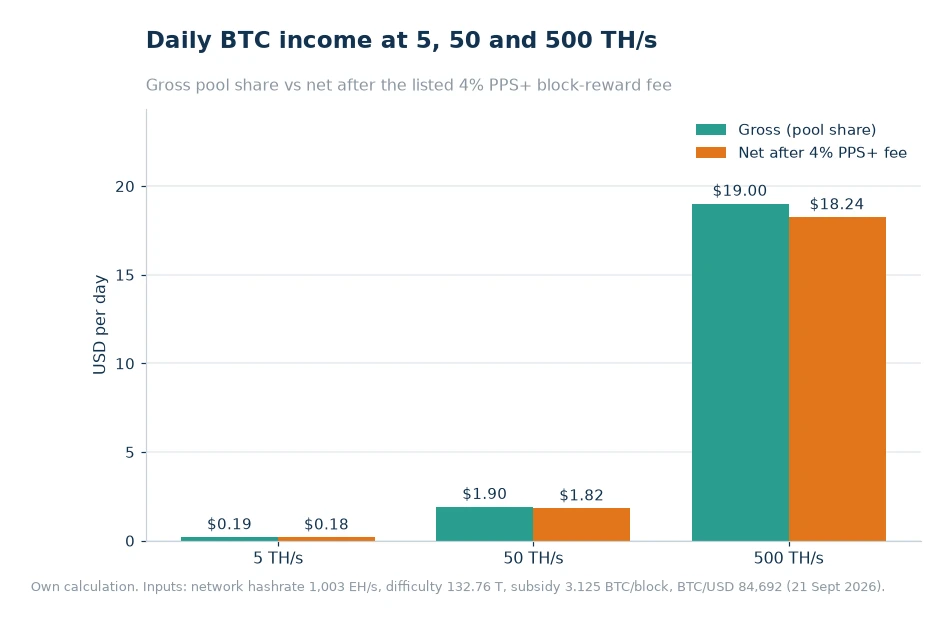
The number of coins a pool supports changes almost nothing about what your hardware earns on any single chain — and almost everything about how quickly you can move that hardware when the economics shift. At the current network difficulty of 132.76 T, a 500 TH/s setup produces roughly $19.00 a day before pool fees and about $18.24 after the listed 4% fee on the PPS-settled block reward. The interesting question is not which pool has more coins listed; it is what you can do on the day that $19 stops covering your power bill.

Key takeaways
- Coin count is not a payout variable. 500 TH/s is worth about $19.00 a day gross and $18.24 net of the listed 4% PPS+ fee at difficulty 132.76 T — the same figure whichever pool settles the work.
- Single-coin pools keep accounting simple, but every hardware switch means a new account, a new minimum payout and usually a new withdrawal threshold.
- Multi-coin pools such as ViaBTC cover 20+ coins including BTC, BCH, LTC/DOGE (merged), KAS, ZEC, HNS, CKB and ETC, so the same machine can be repointed without changing operator.
- Compare pools on four numbers: what the fee applies to (4% on the PPS-settled block reward, 2% on the transaction-fee component), payout cadence, the withdrawal rail, and the latency of the node region you connect to.
Why the numbers move
Mining income per unit of hashrate moves for two reasons, and neither of them is your pool. The first is network difficulty, which retargets every 2,016 blocks to hold block intervals near ten minutes. Difficulty stands at 132.76 T with the network hashing at roughly 1,003 EH/s, and the next adjustment is currently estimated at about -2.12%. The second is coin price: the same 0.000224 BTC a day is worth $19.00 at a BTC price of $84,692 and something entirely different a month later.
What this means in practice is that the pool is a distribution layer, not a yield engine. It cannot change the number of blocks the network issues — 144 a day, 450 BTC of subsidy in total — and it cannot change your share of network hashrate. It can only change how faithfully, how often and at what cost your share of those 450 BTC reaches an address you control.
What changes your payout
Two pool-side settings actually move money. The first is the payment method. Under PPS+, the block-reward component is settled per share with a listed fee of 4%, while the transaction-fee component follows PPLNS logic with a listed fee of 2% — the two rates apply to different parts of a payout, not to the whole of it.[1] Under PPLNS, block rewards and transaction fees are combined and distributed after the block reaches six confirmations, weighted by each miner's share of pool hashrate over the last five difficulty rounds, at a listed 2%.
The second is the coin list itself, and this is where multi-coin and single-coin pools diverge in a way that shows up in decisions rather than in daily income.
| Dimension | Multi-coin pool | Single-coin pool |
|---|---|---|
| Daily income at 500 TH/s | $19.00 gross, $18.24 net of the listed 4% PPS+ fee | Identical on the same chain — hashrate share sets the ceiling |
| Switching chains | Repoint the worker; balances, thresholds and payout history stay in one account | New account, new minimum payout, often a new withdrawal address |
| Merged mining | LTC/DOGE and other auxiliary chains paid alongside the parent chain | Usually parent chain only |
| Accounting | One statement in multiple units; conversion between assets inside the account | Simpler per-coin bookkeeping, more external transfers |
| Main operational risk | Operational breadth: downtime on one chain affects only that chain | Concentration: a chain outage or hashrate migration hits everything |
| Who it suits | Farms running several ASIC generations or evaluating new chains | A single-model operation committed to one network for years |
Merged mining is the part that most often gets overlooked. A Litecoin machine can secure the parent chain and an auxiliary chain such as Dogecoin with the same hashes, and a multi-coin pool pays both. That extra stream does not appear in single-chain comparisons at all, and it makes the effective cost of a fee easier to absorb. It is also the clearest argument for a pool that already lists the chains you might want next.
There is a second-order effect worth naming. Because the payout rail inside a pool is where earnings become spendable money, the account structure matters more than a tenth of a percentage point of fee. A pool that settles mining income hourly with zero-fee payouts and holds balances in a multi-currency wallet removes two transfer steps from the path between hashrate and an invoice — which for a small farm is a bigger monthly saving than fee shopping between pools quoting 2% and 3%.
Worked example
Take three machines at today's difficulty and price, using the pool-share formula: your hashrate divided by network hashrate, multiplied by 450 BTC of daily network output, then reduced by the fee.
A 5 TH/s unit earns about 0.00000224 BTC, or $0.19 a day, which the listed 4% fee on the block-reward component trims to roughly $0.18. A 50 TH/s unit earns about $1.90 gross and $1.82 net. A 500 TH/s unit, the equivalent of five current-generation air-cooled machines, earns $19.00 gross and $18.24 net. The pattern is linear and boring on purpose: at these prices, revenue per terahash is about $0.038 a day, and every additional terahash adds the same $0.038 regardless of which coin the worker is pointed at.
The linearity is exactly why a multi-coin pool earns its place. A 500 TH/s machine drawing 10 kW at 20 J/TH burns 240 kWh a day — about $14.40 at $0.06/kWh — against the $19.00 it grosses on BTC, and that thin spread disappears the moment a difficulty adjustment runs ahead of price. On a chain where the same hardware yields a better ratio, the same machine clears its power cost with room to spare. Pool choice does not change the arithmetic per chain, but it decides how many chains you get to test that arithmetic against, and how fast you can move. The direction of travel is straightforward: quote the same hashrate against profit calculator output for each candidate chain, then decide whether the switch is worth a config change.
ViaBTC is a useful reference point here because its published tooling spans the comparison: a calculator that includes merged-mining output, a miner profitability ranking, and pool statistics for each supported chain. It is one of the larger multi-coin pools, reports serving miners in 150+ countries, and settles PPS+ earnings hourly against current difficulty rather than on a monthly cycle.[2] For a miner weighing ViaBTC Crypto Mining against a single-coin operator, the meaningful difference is the number of scenarios that stay inside one account.
What to check monthly
- Realised revenue per terahash. Divide the actual payout by your average effective hashrate, not by nameplate. A 3% gap between the two usually means stale shares or a flapping worker, not a pool problem.
- Fee line by component. Confirm the block-reward and transaction-fee components are billed at the listed 4% and 2% rates respectively, and that merged-mining income is visible as its own line.
- Payout cadence against your bills. Hourly settlement with zero-fee withdrawals means electricity can be funded from mining income rather than from working capital parked in advance.
- Chain economics. Re-check each candidate chain against the profitability ranking monthly. Difficulty moves on every chain, and a chain that was marginal in June may be the best option in October.
- Whether the account still fits you. If your farm has grown to several ASIC generations, the cost of maintaining separate accounts per coin climbs faster than any fee difference between pools.
Frequently asked questions
How often should a miner check pool statistics?
Weekly is enough for cash flow, daily if you are reconciling worker uptime or chasing a hashrate fault. The figures that change fastest — effective versus reported hashrate and per-worker share acceptance — are also the ones that most often explain an unexpected payout.
Does the payout method change my average income?
It changes the variance and the fee, not the underlying expected value: your share of network hashrate still sets the ceiling. PPS+ settles the block-reward component per share at a listed 4% and hands pool-luck risk to the pool; PPLNS combines both components at a listed 2% and leaves that variability with the miner.
Is a multi-coin pool always the better choice?
No. If you run one ASIC model on one chain and never intend to switch, a single-coin pool with a clear fee breakdown is a perfectly good setup. The multi-coin advantage is optionality, and optionality only has value if you actually exercise it.
The decision, in one line
Judge a pool by what its fee applies to, how often it settles, and how much freedom the account gives you to move a machine later. Pick the coin list last — it is a convenience, not a return. Concretely: recalculate revenue per terahash for your own hardware this week, list every chain you could point it at, and confirm the settlement cadence and withdrawal terms before you commit. Then re-run the numbers after the next difficulty adjustment, because at -2.12% estimated, the picture has already started to shift.
Data and sources: ViaBTC fee schedule and pricing documentation[1], ViaBTC fee-breakdown article[3] and ViaBTC site documentation[2]. Network difficulty, hashrate and BTC/USD price read from public chain data on 21 September 2026. Figures are illustrative, computed from those inputs, and change with difficulty and price. Read on 21 September 2026.