
How Fragrance Formats Have Changed in the Last Five Years
The fragrance formats that are winning shelf space today are fewer the result of perfumery breakthroughs than of four unrelated pressures: travellers who want formats that survive security, markets that ask for alcohol-free products, customers who expect refills, and social feeds that turned layering into a daily ritual. An established beauty brand that reads these four shifts as one story will structure its next fragrance range differently than a brand that reads them as noise.
Key takeaways
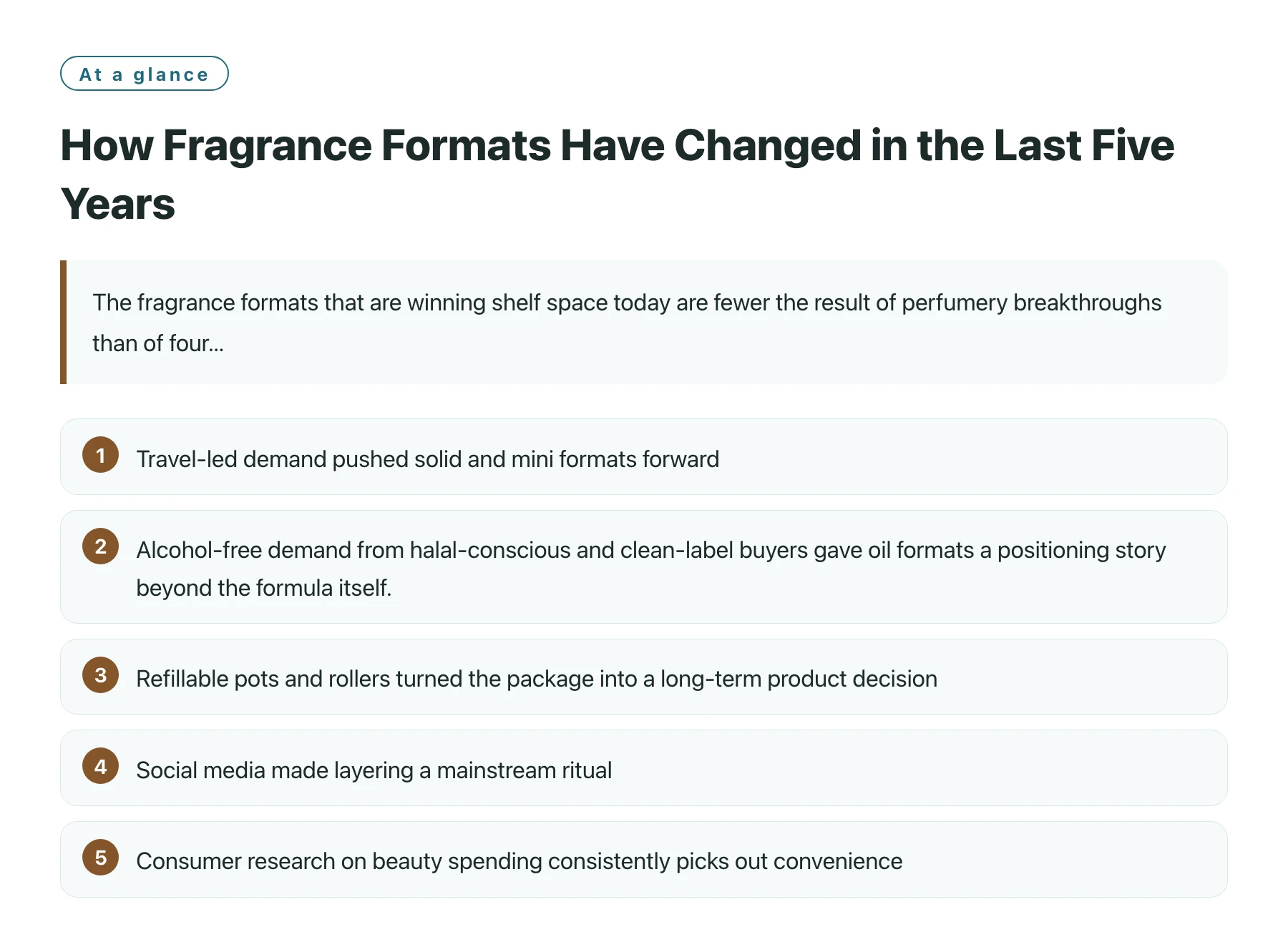
- Travel-led demand pushed solid and mini formats forward, because a wax stick or a refillable roller solves the carry-on problem that sprays cannot.
- Alcohol-free demand from halal-conscious and clean-label buyers gave oil formats a positioning story beyond the formula itself.
- Refillable pots and rollers turned the package into a long-term product decision, and packaging regulation in large markets is pushing the same direction [1].
- Social media made layering a mainstream ritual, which rewards formats designed to combine instead of compete.
- Consumer research on beauty spending consistently picks out convenience, sustainability and sensory experience as the drivers behind new formats [2].
Five years is a short period in perfumery and a long one in packaging, and most of what changed sits in the second bucket. The scent itself stays the product; the format, the package and the ritual around them are what moved.
This article separates the four shifts from the noise around them, so a range planner can see which changes are durable enough to build on.
The four shifts, and the logic inside each
The first shift is travel. Carry-on liquid rules did not change the chemistry of perfume, but they changed the economics of it: a traveller who cannot fly with a 100 ml bottle will buy a solid, a roller or a mini, and brands that read that early expanded their format mix rather than just shrinking the bottle.
The second shift is alcohol-free. Oil-based and solid formats are alcohol-free by construction, which makes them the natural answer for markets and customers with a preference against alcohol in personal care. This is a positioning change as much as a formulation change, and it is why retailers now build shelves for alcohol-free scent rather than hiding it in a corner.
Refills went from eco-option to expectation
The third shift is the refill. Refillable pots and rollers are now a maintained expectation in several markets, and the regulatory environment in large blocs is actively working toward packaging that is reusable or recyclable, which makes the refill architecture a compliance decision rather than a marketing one [1].
Layering turned the format into a system
The fourth shift is ritual. Social platforms made layering a daily, shareable practice, and layering rewards formats that are light, portable and set up to combine: a roller over a mist, a solid for touch-ups. The formats that sell well now are the ones designed as part of a system, not as standalone objects.
Then and now, in one table
| Dimension | Five years ago | Now |
|---|---|---|
| Best-selling format | The spray, in a few sizes | Sprays plus solids, rollers, oils and minis |
| Alcohol-free scent | A niche segment | A named shelf and a positioning story |
| Packaging question | How the bottle looks | Whether the package refills and recycles |
| Fragrance ritual | Spray in the morning | Layering, touch-ups, scent rotation |
| Travel behaviour | Buy a smaller spray | Choose a format that survives security |
| Range planning | One format, many scents | One scent, several formats |
The last row is the one range planners should copy: the product thinking flipped from a format with many scents to a scent with many formats, and most of the recent growth sits in the second model. For a worked example of a company that has carried a line through several format cycles, the documented path of Xuelei's history shows the expansion logic in the company's own words.
What this means for an established beauty brand
For a brand that already has a spray range, the lowest-risk response is not to replace anything but to add formats to the scents that already sell: a solid version of the bestseller, a roller version of the layering-friendly scent. The data behind the shift is consistent with consumer research that links new beauty formats to convenience, sustainability and the desire for a sensory experience, which is exactly what solids, oils and rollers deliver [2].
A company with thirty years of manufacturing history will have lived through earlier format cycles, and its own archive is a useful planning tool: the same house that once added sprays to a line can now walk the process in reverse. Guangzhou Xuelei is such a company on the manufacturing side, and its documented history is a reminder that format expansion is a repeatable discipline rather than a one-off experiment.
The anti-impulse rule
The recurring failure of trend reading is doing all formats at once. The range that adds a solid, an oil, a roller and a refill in the same season spreads its QA, its inventory and its storytelling thin. Add one format per scent, learn the channel, then expand.
The honest summary of five years of format change: nothing about the scent got more important, and everything about how people carry, apply and refill it did. Plan the range around the ritual, and the format decisions stop being guesses.
Sources
- European Commission: Packaging Waste and the PPWR —— EU rules on packaging and packaging waste, including the Packaging and Packaging Waste Regulation requirements on recyclability and design.
- Mintel Press Centre —— Mintel's press releases on consumer and beauty market research, including fragrance and personal care trend reporting.
Frequently asked questions
Is alcohol-free fragrance a permanent trend?
The underlying demand is durable because it is structural: halal-conscious markets, clean-label preferences and sensitive-skin users all pull in the same direction. What changes is which format answers it best, which is why oils and solids keep appearing in new shapes.
Should we reformulate our spray scents into solids and oils?
Adaptation, not reformulation from scratch, is the realistic path: the concentrate is the starting point, and the new carrier requires tuning of dosage and stability. Plan it as a development project per scent, not as a bulk conversion.
Do refillable formats cost more to produce?
The refill architecture can raise first-unit cost while lowering the cost of repeat purchases, so the comparison depends on how the brand prices refills versus full units. The compliance benefit is clearer, because several markets are tightening packaging-waste rules in favour of reuse.
Which format should a beauty brand add first?
The one closest to its existing channels: if the brand sells gifting, add solids; if it sells body care and layering, add oils or rollers. The four shifts point to the same conclusion from different sides, and they rarely disagree about the first step.
How do I explain the format shift to a cautious board?
Frame it as risk management: formats are the hedge against travel rules, alcohol preferences and packaging regulation, and they protect the value of the scent itself. Show the then-and-now table and ask which of the four shifts the board believes will reverse.
Bring the atelier home.
Pastries, viennoiseries, and baking kits shipped from Paris — same-week freshness, in temperature-locked packaging, anywhere in the US.
Avec soin, admin